Fee and review audit · October 2026
Substack Review (2026): Is the 10% Cut Worth It for You?
We rebuilt Substack's fee math from its own help center, pulled ratings from four review sites, and listed what the 10% cut does and does not buy you.
Summary
This Substack review audits what the platform costs and what it gives back. Substack is free to publish, but once paid subscriptions are on, the real cut is 14% to 20% of each payment after Stripe fees, not the 10% on the label. Discovery through Notes and Recommendations is the real asset. Support is the weak spot: Trustpilot sits at 1.4/5 across 181 reviews. Our verdict is 7.0/10 for writers and podcasters who need reach more than margin.
Substack is free to publish and keeps 10% of paid subscriptions, but with Stripe's fees the real cut is 14% to 20% of each payment: $1.39 on an $8 plan, or 17.4%. Our verdict is 7.0/10. It is the easiest way to start charging readers and the best built-in discovery of any newsletter tool, but support is thin and the Trustpilot score is 1.4/5.
- Setup and publishing
- 9/10
- Discovery and growth
- 8/10
- Effective fees
- 5/10
- Support and trust
- 3/10
- Customization and automation
- 4/10
- Data portability
- 6/10
- No monthly fee: you pay nothing until a reader pays you
- Notes, Recommendations and leaderboards bring readers without ad spend
- Newsletter, podcast, video and chat live in one publishing flow
- The real cut is 14% to 20% per payment once Stripe fees stack on the 10%
- Support is mostly automated and Trustpilot shows 1.4/5 across 181 reviews
- Design and automation are minimal compared with flat-fee tools
Free to start, 10% only on paid subscriptions
How we audited Substack
- Plan paid
- None (free publishing; fee schedule read from the Help Center)
- Version tested
- Substack web, help center and public marketing pages, October 2026 snapshot
- Test period
- 2026-10-22 → 2026-10-24
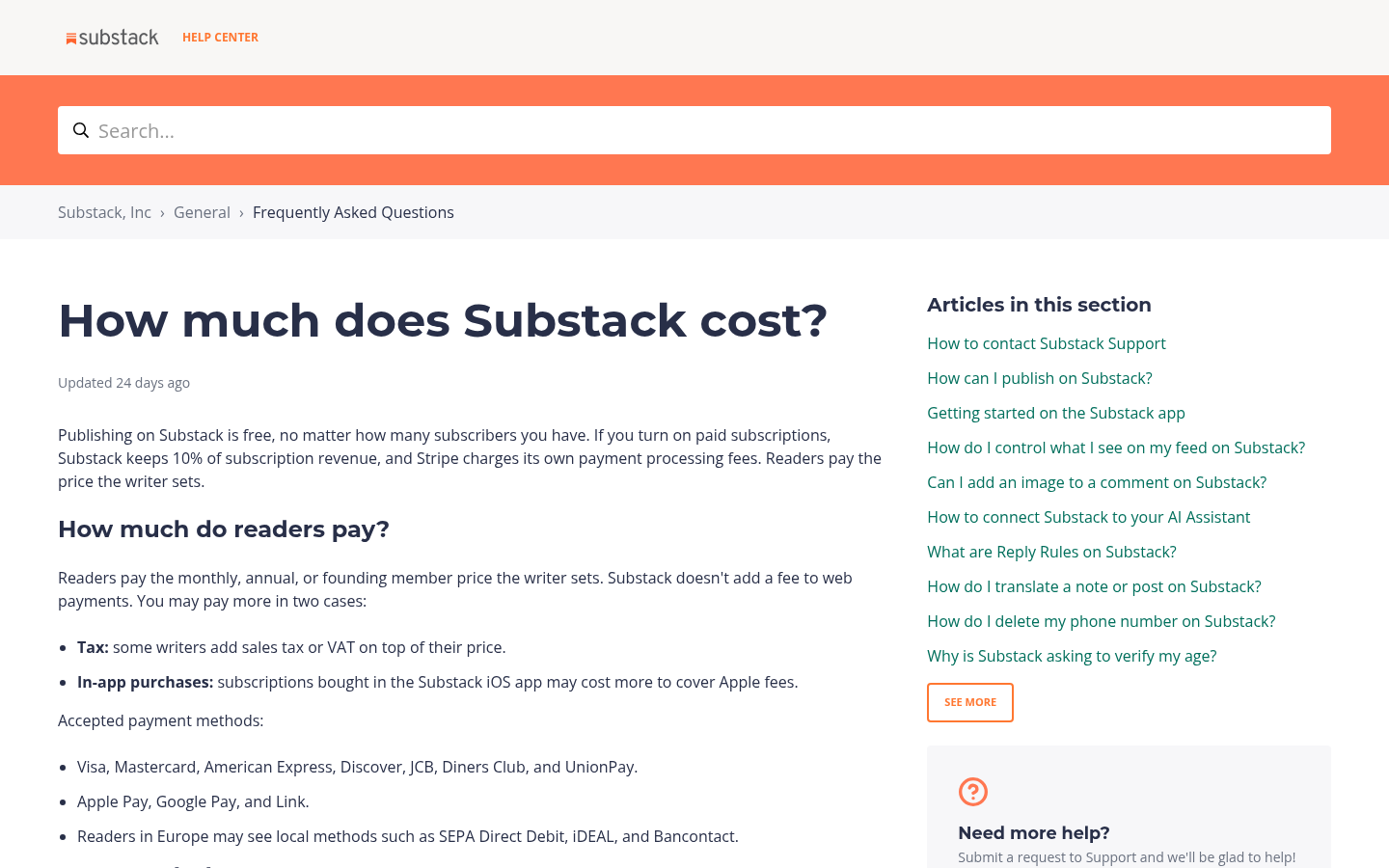
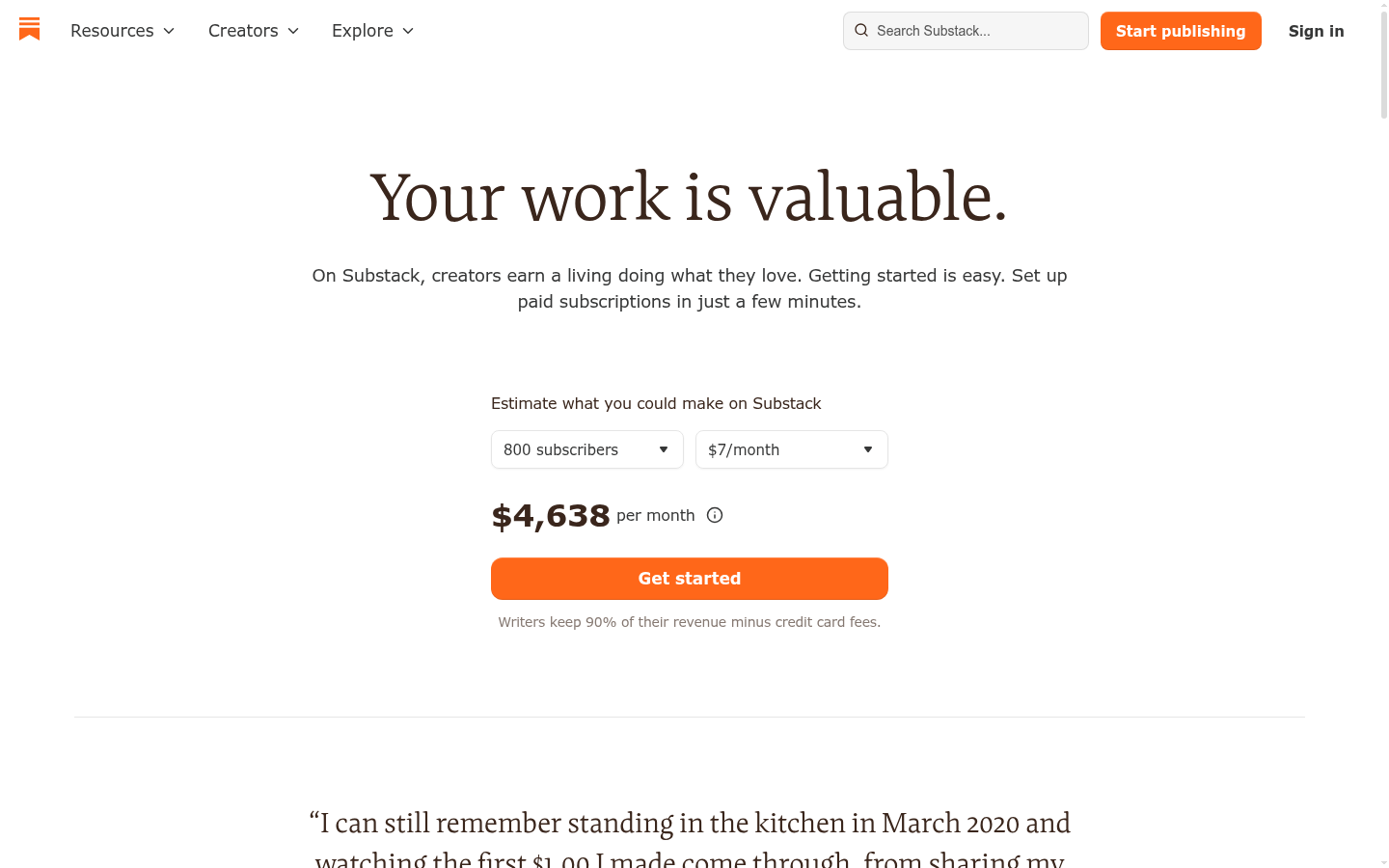
This is a desk audit, not a 30-day paid test, and we want you to know that before you trust any number. Between October 22 and 24, 2026 we read Substack's own 'How much does Substack cost?' help page, its going-paid revenue calculator, its features page and its Substack vs Patreon page, and we captured screenshots of each. We then rebuilt the effective fee on five price points ($5, $8, $10, $50 and $70) using the fee table Substack publishes: 10% platform share, Stripe card processing at 2.9% + $0.30, and Stripe Billing at 0.7% for recurring payments. Ratings were read live from Trustpilot, G2 and Product Hunt, and creator sentiment from public Reddit threads. Capterra has no Substack listing, so it is not counted. We did not measure latency, deliverability or payout timing, because we did not run subscribers through it.
Should you build on Substack?
YES if you...
- Writers and podcasters starting from zero who need built-in discovery more than a custom design
- Creators who want paid subscriptions live in an afternoon, with no site to maintain
- Anyone testing whether readers will pay before committing to a monthly platform fee
NO if you...
- Creators already above roughly $2,000 a month in paid revenue, where a flat fee can undercut a 10% share
- Brands that need custom design, deep automation or segmentation beyond a couple of welcome emails
- Anyone who cannot afford a support gap: help is mostly automated, so a locked account can stall for weeks
What Substack really costs per payment
Publishing is free. The cost appears the day you switch on paid subscriptions.
Free publishing
Newsletter, podcast, video and Notes
- Unlimited free subscribers
- Notes, Recommendations and the Explore page
- Subscriber and post export
- No platform fee until you charge readers
Paid subscriptions
Plus Stripe: 2.9% + $0.30 per card payment, 0.7% Billing fee
- $8 plan: $1.39 total fees, you keep $6.61 (17.4%)
- $50 annual plan: $7.10 total fees, you keep $42.90 (14.2%)
- Reader sets the price; founding member tier available
- Coupons, gift subscriptions and free trials included
Custom domain
Optional
- Use your own domain name
- Paid once, not monthly
ROI breakdown: The label says 10%, but the effective cut we calculated is 19.6% on a $5 monthly plan, 17.4% on $8, 16.6% on $10, 14.2% on a $50 annual plan and 14.0% on $70. Low monthly prices pay the most, because Stripe's fixed $0.30 hits every payment. At $1,650 in monthly paid revenue, Substack's 10% share alone equals $165 a month.
Hidden costs & gotchas
- Stripe's $0.30 fixed fee makes cheap monthly plans the most expensive per dollar earned
- The 0.7% Stripe Billing fee on recurring payments has applied since July 2024 and is not in the headline 10%
- iOS in-app purchases can cost readers more to cover Apple fees, and Substack's 10% is based on your web price
- SEPA Direct Debit failures or disputes cost $10.00 each on a US Stripe account
The numbers behind this review
Fee figures are our arithmetic on Substack's published table. Ratings were read on each platform in October 2026.
- Platform fee on paid subscriptions
- 10% of each payment Substack Help Center, 'How much does Substack cost?', Oct 2026
- Effective total fee, $8/month plan
- 17.4% $1.39 per payment 10% + Stripe 2.9% + $0.30 + Billing 0.7%; creator keeps $6.61
- Effective total fee, $50/year plan
- 14.2% $7.10 per payment Same fee table; creator keeps $42.90
- Effective total fee, $5/month plan
- 19.6% $0.98 per payment Fixed $0.30 Stripe fee weighs most on low prices
- Share reaching the creator, official calculator
- 82.8% of $5,600 gross Going-paid page: 800 subscribers at $7/month shows $4,638 per month
- Trustpilot rating
- 1.4 /5 across 181 reviews Unclaimed profile, read Oct 2026; themes: billing, cancellation, support, spam
- G2 rating
- 4.3 /5 across 17 reviews 70% five-star, 5% one-star; unclaimed profile
- Product Hunt rating
- 3.8 /5 across 13 reviews Praise for reading app; complaints about editor, stats, Stripe-only payments
- Custom domain
- $50 one time Help Center fee table
What does Substack say it costs, and who pays Stripe's fees?
What take-home does Substack's own revenue calculator promise?
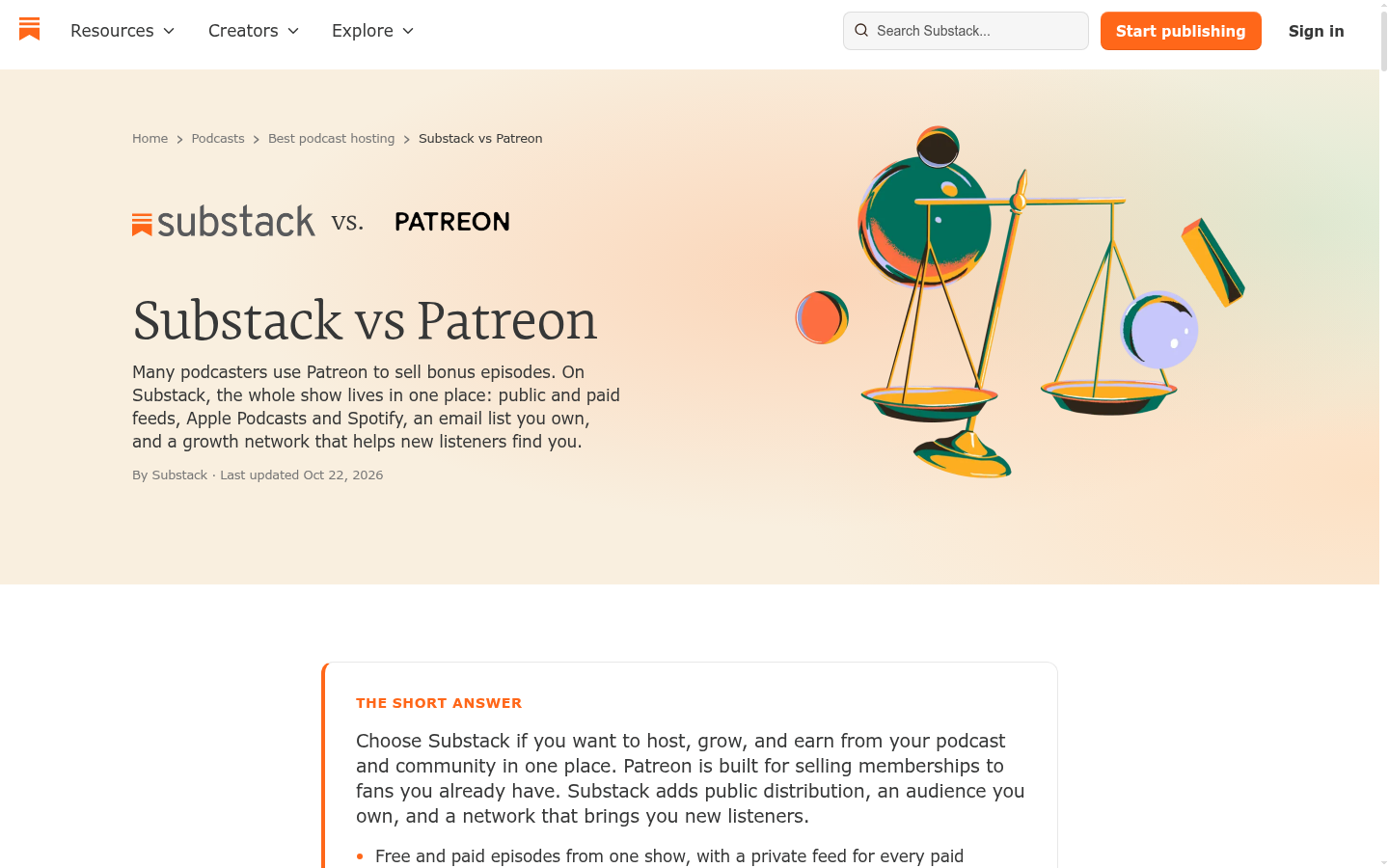
How does Substack position itself against Patreon?
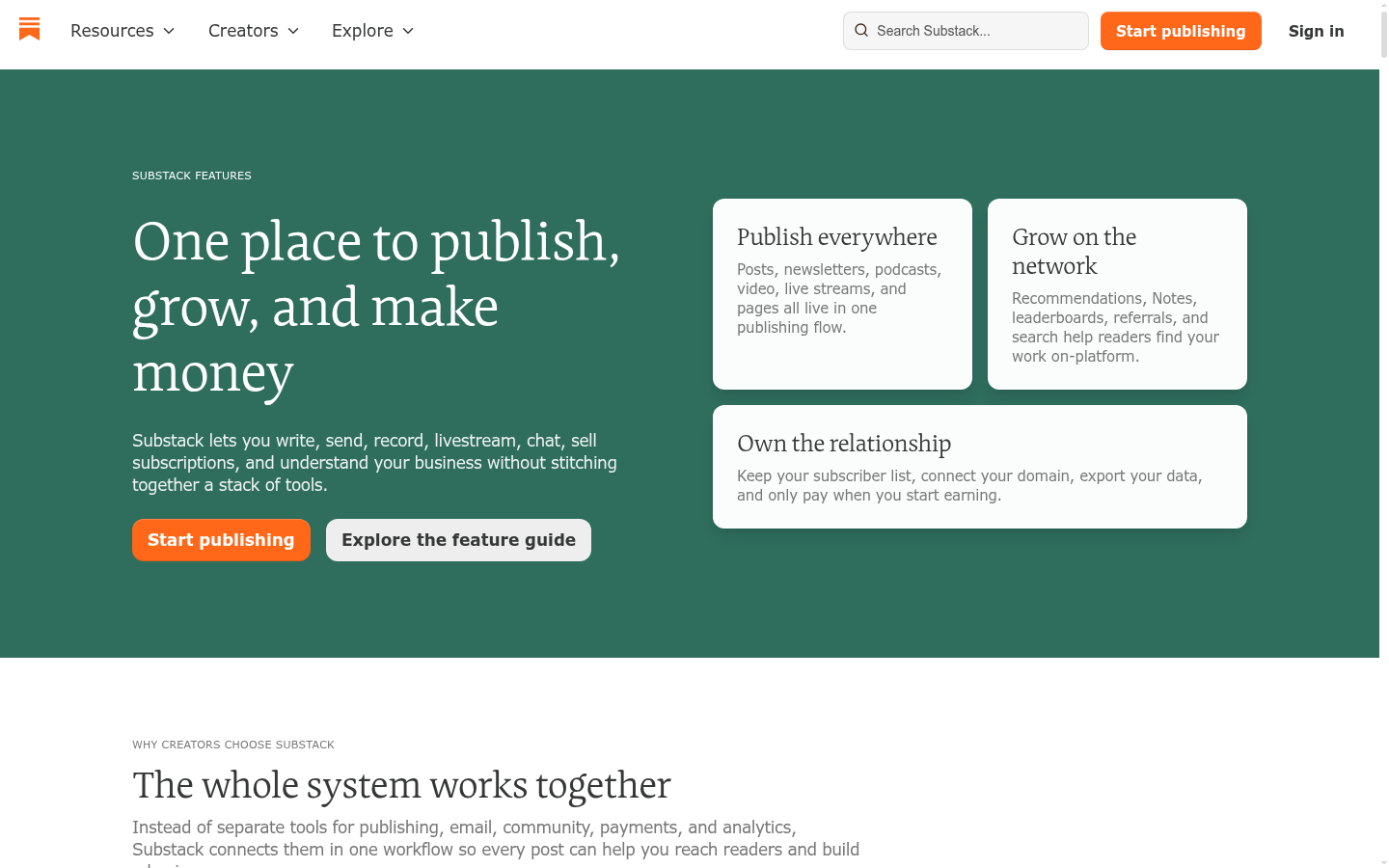
What is included on the free tier of publishing?
Pros and cons of Substack
Pros
- You can charge readers in an afternoon Setup runs through Stripe Connect and a handful of toggles. There is no site to host, no plugin to update and no monthly bill before your first paying reader.
- Discovery is built in and it works Substack's own page claims over half of new subscribers come from inside the network. Treat that as a vendor claim, but the Recommendations and Notes tools are the reason writers stay.
- One tool covers text, audio, video and chat Podcast hosting with private paid feeds, native video, live streams and subscriber chat sit inside the same publication, which cuts the number of subscriptions you pay for.
- Migration in is easy Substack imports posts from WordPress, Ghost, Beehiiv, Mailchimp and any RSS feed, and can import paid subscribers from Stripe or CSV.
Cons
- The real cut is 14% to 20% of each payment At $5 a month you keep $4.02. The fixed $0.30 and the 0.7% Billing fee are easy to miss behind the 10% headline.
- Support is mostly automated with a poor trust record Trustpilot shows 1.4/5 across 181 reviews, with recurring stories about auto-renewals, cancellation trouble, unwanted signups and account blocks. Those are mostly reader-side complaints, but they shape how readers see your publication.
- Design, automation and segmentation are thin Every publication looks similar, and Product Hunt reviewers call the editor basic. Serious email programs outgrow it.
- Payments depend on Stripe alone Creators in countries Stripe does not support cannot take paid subscriptions, a limit Product Hunt reviewers mention.
- Your audience lives partly inside Substack's network You can export posts and subscriber lists, but Notes activity and network discovery do not move with you. Reddit threads about leaving say you lose some of that reach.
Final verdict
Substack earns a 7.0 out of 10 because it solves the hardest early problem for a creator: getting your first paying readers without building anything. The platform charges nothing until you do, discovery is real, and one publication can hold a newsletter, a podcast and a chat. If you are under a few hundred paying readers, that trade is easy to defend.
Where the score drops is the bill and the safety net. A 10% label becomes 14% to 20% per payment once Stripe's fees stack, and the smaller your plan, the worse it looks: 19.6% on a $5 monthly price. Support has the weakest record in this audit, with a 1.4/5 Trustpilot score across 181 reviews and a pattern of automated replies.
Our advice is practical. Start on Substack if you need reach and speed, price your plan so Stripe's $0.30 matters less, keep a copy of your subscriber list outside the platform, and rerun the fee math when your monthly paid revenue passes about $2,000. Past that point, a flat-fee tool may leave more of your own money in your hands.
- Setup and publishing 9/10 Paid subscriptions in an afternoon
- Discovery and growth 8/10 Notes and Recommendations bring readers
- Effective fees 5/10 14% to 20% per payment
- Support and trust 3/10 1.4/5 on Trustpilot
- Customization and automation 4/10 Minimal design, basic automation
- Data portability 6/10 Export and Stripe import, but network reach stays
Common questions about Substack
Is Substack free?
How much does Substack really take from a paid subscription?
Is Substack legit, or a scam?
Is Substack better than Patreon for creators?
Can you take your subscribers with you if you leave Substack?
Does Substack have an app and a podcast host?
Who should not use Substack?
How many reviews does Substack have on G2 and Trustpilot?
Update log
- Initial publication: fee audit rebuilt from the Substack Help Center plus ratings read on Trustpilot, G2 and Product Hunt.